There’s an compelling idea lurking beneath Killer Whale: a trauma drama dressed up as a creature feature. Director Jo-Anne Brechin frames her survival thriller around grief, survivor’s guilt and damaged ambition, using the rampaging orca less as a monster and more as an externalisation of unresolved pain. It’s a thoughtful angle in theory — but one that struggles to stay afloat amid the film’s more formulaic genre trappings.
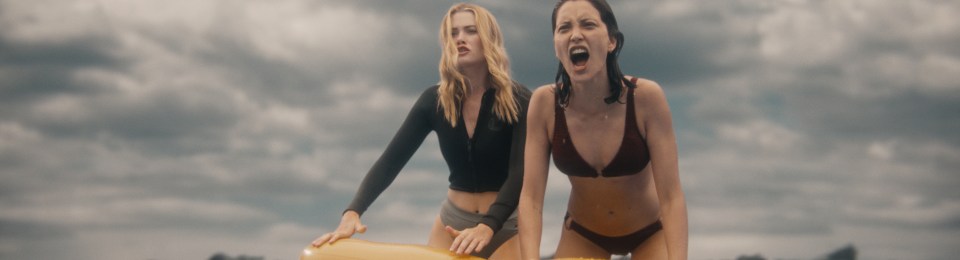
The story follows Maddie (Virginia Gardner), a gifted cellist whose life stalls after a violent robbery leaves her hearing impaired and her boyfriend dead. A year later, a guilt-ridden holiday to Thailand with her friend Trish (Mel Jarnson) spirals into nightmare territory when an abused captive orca is unleashed into a secluded lagoon. What begins as an emotional reckoning quickly pivots into familiar killer-creature beats: stranded swimmers, tightening geography, and a predator circling with mechanical persistence.
Brechin deserves credit for attempting to graft psychological weight onto a well-worn subgenre. The early passages, which explore Maddie’s fractured identity and her complicated relationship with sound and silence, hint at a more introspective film. Gardner carries these quieter moments with conviction, grounding the character’s grief in a way that feels authentic. Yet once the survival mechanics kick in, the emotional throughline becomes increasingly submerged beneath routine suspense staging.
Compared to the great killer-creature touchstones — from the elegant dread of Jaws to the lean efficiency of modern aquatic thrillers — Killer Whale feels caught between ambitions. The orca itself is an effective symbol of exploitation and rage, but the visual execution varies wildly, with tension undercut by uneven effects and repetitive attack rhythms. The lagoon setting promises claustrophobia but rarely capitalises on its full spatial potential, resulting in sequences that feel more cyclical than escalating.
What works best is the film’s thematic intent: the suggestion that trauma, like a wounded animal, will keep circling until confronted. What doesn’t is the script’s tendency to spell out these ideas while relying on stock genre decisions that blunt their impact. Characters make frustrating choices less out of psychological necessity than narrative convenience, and the pacing sags in a middle stretch that should be tightening the screws.
The Prognosis:
Killer Whale never entirely bores, and its central metaphor gives it a faint pulse beyond standard creature-feature thrills. But the disconnect between its emotional aspirations and its execution leaves it feeling like a sketch of a stronger film — one where trauma and terror might have truly reinforced each other, rather than competing for the spotlight.
- Saul Muerte
Killer Whale will be available to rent on digital platforms from Feb 20.
 Surgeons of Horror