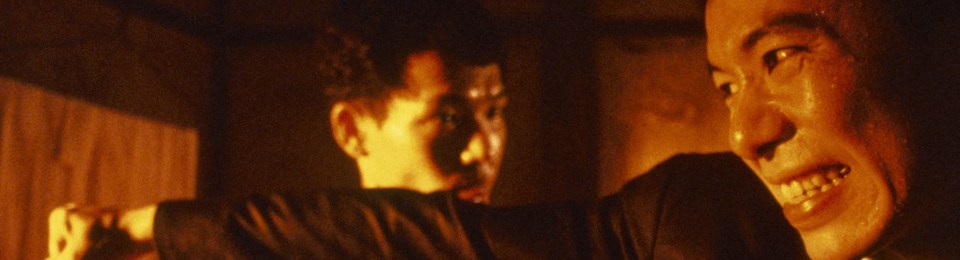
When Tokyo Fist exploded onto screens in 1995, it was less a film than a sensory assault — a hallucinatory plunge into the body and the city, where love, rage, and industrial noise fused into something both grotesque and transcendent. Thirty years on, Shinya Tsukamoto’s bruised masterpiece still feels electrifying, a raw depiction of masculine collapse that punches with every frame.
Following Tetsuo: The Iron Man and Tetsuo II: Body Hammer, Tsukamoto turned his kinetic eye inward, shifting from techno-flesh obsession to the violence that seethes beneath modern alienation. The story seems simple: a meek salaryman, Tsuda (played by Tsukamoto himself), reunites with a childhood friend turned boxer, Kojima, and suspects him of seducing his fiancée, Hizuru (Hisashi Fujii). But in Tsukamoto’s world, suspicion is only the spark — what follows is an implosion of jealousy and self-destruction that blurs the lines between punishment, passion, and transcendence.
As Tsuda trains and reshapes his body into a weapon, the film mutates into a study of transformation — not heroic, but pathological. His bruises and cuts become symbols of rebirth, his pain the only way to feel alive amid Tokyo’s oppressive sprawl. Tsukamoto’s editing and camerawork — all whiplash movement and oppressive close-ups — turn every punch into a scream of existential agony.
There’s also a surprising tenderness beneath the steel. Hizuru’s own evolution, from passive fiancée to self-actualising force, brings balance to the film’s masculine ferocity. Tsukamoto’s vision is never merely about brutality; it’s about connection through suffering and finding the pulse of life in the noise of decay.
Three decades later, Tokyo Fist remains a testament to Tsukamoto’s ability to merge the physical and the psychological into pure cinematic expression. It’s as vital, exhausting, and hypnotic as ever — a bruised valentine to the body under siege and the madness that lurks beneath the surface of civility.
The Prognosis:
A feral, intimate, and unforgettable piece of Japanese cyberpunk melodrama, Tokyo Fist still lands its blows with unflinching force. Tsukamoto’s vision is as vital today as it was in 1995 — both brutal and strangely beautiful.
- Saul Muerte
 Surgeons of Horror