Tags
100 years, Lon Chaney, phantom of the opera, silent film, silent horror, Universal, Universal Horror
In the dim candlelit corridors and vertiginous staircases of The Phantom of the Opera lies a deep debt to German Expressionism—a cinematic movement that left an indelible mark on horror during the silent era. While the film is proudly American, its visual soul often drifts through the distorted dreamscapes of German classics like The Cabinet of Dr. Caligari (1920) and Nosferatu (1922), whose stylised aesthetics helped shape the visual grammar of horror cinema.
Though Phantom doesn’t lean fully into the extreme angularity and painted shadows that defined Expressionist sets, its moody chiaroscuro lighting, cavernous lairs, and symbolic use of architecture all channel the spirit of the movement. The Paris Opera House becomes a labyrinthine purgatory, with secret doors, subterranean lakes, and impossibly steep staircases that twist and descend like something from a fevered hallucination.
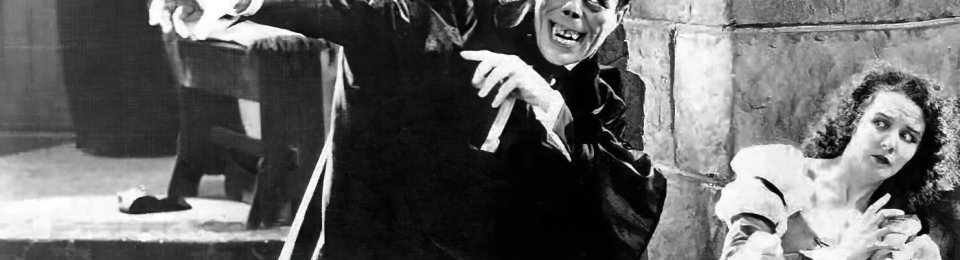
Lon Chaney’s Phantom, too, feels born of this tradition—his grotesque visage and tortured, isolated psyche akin to Caligari’s Cesare or Murnau’s Count Orlok. He is less monster than metaphor: a manifestation of anguish, obsession, and decay lurking beneath society’s grandest stage. Expressionism reveled in such figures—outsiders who moved through broken worlds, their inner torments reflected in warped surroundings. In Phantom, the opulence of the opera is a fragile mask over this subterranean madness.
Universal’s production didn’t imitate German Expressionism so much as absorb it, combining its stylised shadows with Hollywood scale and narrative structure. The result was a transatlantic hybrid: a film both gothic and grotesque, tethered to American melodrama yet haunted by European horror. And this synthesis would prove influential. Just a few years later, Universal would lean more heavily into Expressionist stylings with Dracula (1931) and Frankenstein (1931), cementing a house style that echoed the shadows of Weimar cinema.
The Phantom of the Opera may not always be cited alongside Caligari or Nosferatu in academic treatises on Expressionism, but its DNA is unmistakable. It stands as one of the first major American horror films to weave that spectral influence into the foundations of studio filmmaking—proof that the horror genre, even in its infancy, was already a global dialogue in shadows and silence.
- Saul Muerte
The Heart of the Monster: Romance, Obsession, and the Tragic Outsider
 Surgeons of Horror
Pingback: A Film in Pieces: The Production Chaos Behind the Curtain | Surgeons of Horror
Pingback: Wolf Blood (1925) — A Century Later, Still Howling for a Pulse | Surgeons of Horror