• About
  • podcasts
  • Shop

Surgeons of Horror

~ Dissecting horror films

Surgeons of Horror

Monthly Archives: August 2025

The Prophecy (1995): Heaven’s War, Earth’s Weirdness

31 Sunday Aug 2025

Posted by surgeons of horror in retrospective

≈ 1 Comment

Tags

amanda plummer, christopher walken, elias koteas, eric stoltz, prophecy, viggo mortensen, virginia madsen

Gregory Widen’s The Prophecy is one of those mid-’90s supernatural thrillers that feels caught between the sacred and the schlocky. It leans heavily on biblical mythology, unpacks celestial civil war, and casts Christopher Walken as a renegade archangel—already a recipe for cult appeal. And yet, while its ambition sometimes outpaces its execution, the film still lingers in the memory nearly three decades later.

The plot hinges on a war in Heaven that has spilled onto Earth, with Gabriel (Walken) searching for a dark human soul that could tip the divine balance. Standing in his way are a former priest turned cop (Elias Koteas) and a young girl unknowingly carrying the fate of existence within her. The theological stakes are enormous, but Widen’s script often feels more like a term paper on angelology than a streamlined narrative.

What truly elevates the film is its cast. Christopher Walken is electric as Gabriel—quirky, menacing, and strangely funny. His line delivery alone gives the film an off-kilter energy that keeps things lively even when the plot meanders. Meanwhile, Viggo Mortensen steals his few scenes as a soft-spoken, snake-charming Lucifer, oozing charm and threat in equal measure. His entrance, late in the film, is so striking it nearly rewrites the tone altogether.

Despite its rich celestial lore and a few standout moments, The Prophecy is ultimately weighed down by its allegorical excess and patchy pacing. The script sometimes trips over its own gravity, and the visual effects—modest even by 1995 standards—haven’t aged gracefully.

The Prognosis:

Still, there’s a strange allure to Widen’s debut. It’s messy, yes, but it takes big swings. And in the shadow of countless formulaic horror-thrillers of the era, that ambition counts for something. Add in a memorable score, a few genuinely eerie moments, and a cast clearly relishing the material, and The Prophecy remains an imperfect yet intriguing entry in the religious horror canon.

  • Saul Muerte

Dead Wrong: Snatchers Revives The Body Snatcher with Aussie Dark Humour

30 Saturday Aug 2025

Posted by surgeons of horror in Movie review, Sydney Underground Film Festival

≈ Leave a comment

Tags

Craig Alexander, Hannah McKenzie, Justin Hosking, Shelly Higgs, suff, Sydney Underground Film Festival

Dark comedy has always thrived on uncomfortable juxtapositions, and Snatchers, the Canberra-made debut from directors Craig Alexander and Shelly Higgs, gleefully leans into the clash between the morbid and the mundane. A contemporary riff on Robert Louis Stevenson’s The Body Snatcher, refracted through the lens of Australian gallows humour, it delivers a brisk, twisty tale of desperation, friendship, and the fine line between survival and exploitation.

The set-up is deceptively simple. In a near-dystopian Australia, lifelong friends Mac (Alexander) and Fettes (Justin Hosking) eke out a living as undervalued, underpaid orderlies. When a Jane Doe rolls into their orbit, seemingly a fresh candidate for organ harvesting, the duo sees an opportunity to cash in on their grim surroundings. But when the corpse proves not to be as dead as expected, their plan mutates into a moral and logistical quagmire — a farcical spiral of bad decisions, shifting allegiances, and grim comedy.

What distinguishes Snatchers is not just its premise, but its tonal balancing act. The film operates as a modern Australian take on the Burke and Hare mythos, where grave-robbing becomes a working-class hustle. Yet, instead of solemn Gothic horror, Alexander and Higgs infuse the narrative with a distinctly local irreverence. The humour is dry, the banter unpolished, and the absurdity of the situation constantly undercut by the casual bluntness of its characters. Where a British version might lean into macabre wit, Snatchers feels bracingly Antipodean — equal parts cheeky, grim, and self-deprecating.

Hannah McKenzie, as the not-so-dead Jane Doe, injects a lively volatility into the proceedings, a reminder that the “corpse” has agency of her own and won’t be easily reduced to commodity. The film finds much of its energy in this disruption, forcing Mac and Fettes to navigate not only their friendship but the moral sinkholes of their scheme. The twists come quickly, some predictable, others slyly surprising, but always tethered to the film’s central question: how far will ordinary people bend ethics when the system leaves them with so little to lose?

Though undeniably modest in scale and budget, Snatchers makes a virtue of its scrappy production. Its humour doesn’t always land cleanly, and its narrative leans into familiar beats, but the sheer audacity of its premise — and the willingness to entwine Stevenson’s gothic lineage with Australian socio-economic bite — keeps it engaging. As a festival entry, it embodies the SUFF spirit: resourceful, transgressive, and proudly unpolished, a film that finds life in the margins where mainstream cinema rarely dares to tread.

The Prognosis:

At 80 minutes, Snatchers doesn’t overstay its welcome. Instead, it lingers in the uneasy laughter it provokes — laughter that’s always one step away from horror, one step away from despair.

  • Saul Muerte

SUFF – Snatchers
Unrated 15+
Starts Thursday, September 11, 2025 · Comedy · 1 hr 20 min

Between Dream and Delirium: Julie Pacino’s I Live Here Now Blurs Reality into Madness

30 Saturday Aug 2025

Posted by surgeons of horror in Movie review, Sydney Underground Film Festival

≈ Leave a comment

Tags

cara seymour, julie pacino, lucy fry, madeline brewer, matt rife, sheryl lee, suff, Sydney Underground Film Festival

Julie Pacino’s debut feature announces itself less as a narrative than as a hypnotic state of being. With I Live Here Now, she crafts a film that drifts between dream, paranoia, and fractured identity, where each scene feels like a step deeper into a psychological labyrinth. It is a strikingly assured first feature, one that refuses to provide a map, demanding instead that its audience surrender to its vertiginous rhythms.

Lucy Fry, in a career-defining performance, embodies Rose, a young actress who retreats to a remote hotel in Idyllwild, California, in search of respite from her unraveling life. But the more she seeks refuge, the more porous the walls of her reality become. Time loops back on itself, doubles materialise, and memory seeps into performance until the categories lose meaning altogether. Fry is magnetic precisely because she grounds this hallucinatory descent in something tangible: the unease of someone who no longer trusts her own perceptions.

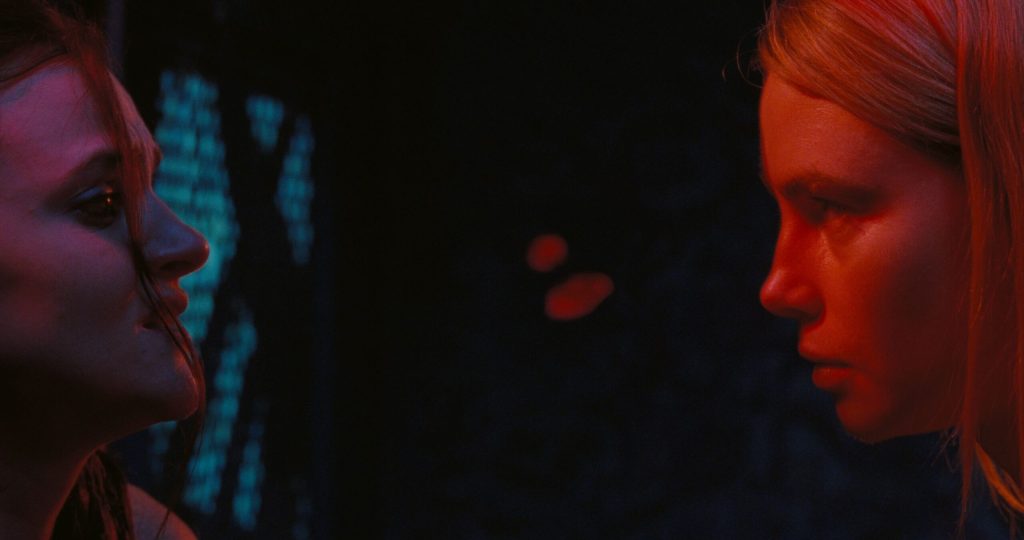
Pacino wears her influences with confidence. Sheryl Lee’s presence inevitably conjures the spectre of Twin Peaks, and David Lynch’s fingerprints are felt in the film’s elastic time, uncanny repetitions, and ominous hum that seems to vibrate through the very air. Yet Pacino’s aesthetic is not mere homage. Her saturated colour palette recalls Argento’s lush operatics, while the film’s elliptical logic suggests Buñuel’s surreal provocations. Layered on top is a contemporary awareness of performance itself — how identity, memory, and desire are all rehearsed roles, prone to fracture under pressure.

Shot on 35mm, the film achieves a tactile, dreamlike fragility. Every frame looks like a half-remembered photograph, poised on the edge of fading. The supporting cast — Madeline Brewer, Cara Seymour, Sheryl Lee, and a gleefully slippery Matt Rife — all slot into the hallucinatory mood, each embodying figures that may be confidantes, doubles, or projections of Rose’s disintegrating psyche. The film offers no clear answers; its power lies in its refusal to resolve whether we are witnessing dream, reality, or a fragmented plurality of selves.

If Tokyo Evil Hotel was SUFF’s splatter assault on the senses, then I Live Here Now is its slow, intoxicating hypnosis. It burrows into the subconscious and gnaws away at the seams of certainty, drawing the viewer into a space where dread and desire cohabit uneasily. As Rose descends, so do we — through layers of paranoia and fractured selfhood, into the uncanny realisation that the mind itself is the ultimate haunted house.

The Prognosis:

I Live Here Now is not a film to be solved. It is a film to be inhabited, to be surrendered to. And in that surrender, Julie Pacino has crafted a debut that is both daringly elusive and deeply resonant — a Lynchian dream refracted through her own distinct lens.

  • Saul Muerte

SUFF – I Live Here Now
Unrated 15+
Starts Thursday, September 11, 2025 · Drama · 1 hr 36 min

Spinning Into Madness: Pater Noster and the Mission of Light Turns Vinyl into a Psychedelic Curse

29 Friday Aug 2025

Posted by surgeons of horror in Movie review, Sydney Underground Film Festival

≈ Leave a comment

Tags

adara starr, christopher bickel, mission of light, suff, Sydney Underground Film Festival

Christopher Bickel is not a filmmaker interested in polish. He is interested in sweat, noise, and the intoxicating dirt that clings to the celluloid ghosts of exploitation cinema. With Pater Noster and the Mission of Light, his latest DIY descent into the grindhouse abyss, Bickel channels the cracked spirit of 1970s cult horror while infusing it with a distinctly contemporary awareness of obsession — musical, spiritual, and cinematic.

The hook is irresistible: Max, a record store clerk chasing the thrill of rare vinyl, stumbles upon an LP from a long-forgotten commune band called Mission of Light. What begins as crate-digging curiosity spirals into something altogether darker, as Max and her friends trace the record’s origins to a secluded cult whose rituals are soaked in both blood and distortion. Before long, the chiming folk harmonies become incantations, the needle-drop becomes a curse, and the grooves themselves seem to open onto a world of psychedelic terror.

Bickel, whose underground reputation was forged on unapologetically abrasive, micro-budget projects, makes no effort to hide the seams. In fact, the seams are the point: a stitched-together tapestry of lurid colour, stroboscopic editing, and gory practical effects that recall the handmade ferocity of vintage splatter cinema. The budget is meager, but the imagination is unruly. When the film tilts fully into ritual bloodletting and cosmic chaos, it achieves the kind of unhinged sensory overload that expensive horror often can’t touch.

What’s most surprising, though, is the music. The filmmakers wrote and recorded a full album in the guise of Mission of Light, and its jangling, upbeat folk tunes — deceptively sunny, unnervingly catchy — weave through the film like a viral infection. Their recurrence creates a peculiar dissonance: the music seems to gnaw at the edges of the viewer’s mind, becoming both a nostalgic echo of 1970s counterculture and a sinister tool of indoctrination. By the time the cult’s rituals are in full swing, the songs are inseparable from the horror, leaving the audience haunted by melodies as much as imagery.

For all its disjointedness — the pacing takes time to find its grip, and some performances verge on pastiche — the film exerts a strange cumulative power. It sneaks up on you, wearing you down with repetition and atmosphere until its final stretches feel like an outright possession. It is less a film you watch than one you are slowly, insidiously absorbed into.

The Prognosis:

Pater Noster and the Mission of Light is not for everyone. Its rough edges are sharp, its indulgence in retro exploitation tropes unapologetic. But within SUFF’s lineup, it is precisely the kind of discovery audiences come to this festival for: a work made with passion, sweat, and delirious creativity, chewing through its limitations to deliver something singular. Bickel has crafted a nightmare that’s equal parts grindhouse revival, cult exposé, and vinyl collector’s hallucination — a low-budget hymn that worms its way into your soul, humming as it feeds.

  • Saul Muerte

SUFF – Pater Noster and the Mission of Light
Unrated 18+
Starts Thursday, September 11, 2025 · Horror · 1 hr 37 min

Neon-Bathed Terror: Nishimura’s Tokyo Evil Hotel Haunts and Horrifies

29 Friday Aug 2025

Posted by surgeons of horror in Movie review, Sydney Underground Film Festival

≈ Leave a comment

Tags

suff, Sydney Underground Film Festival, Yoshihiro Nishimura

SUFF 2025 – Where Cult Cinema, Transgression, and Innovation Collide

In the annals of Japanese horror cinema, Yoshihiro Nishimura occupies a singular, slippery niche — one forged in latex, arterial spray, and an irreverent carnival of grotesquery. From Tokyo Gore Police to Helldriver, his films have thrived on excess, turning the body into a site of anarchic spectacle. With Tokyo Evil Hotel, Nishimura returns to his splatter roots but cloaks the viscera in something more spectral, an unnerving meditation on urban legends and the hidden machinery of Japan’s entertainment underworld.

The premise sounds almost folkloric: a cursed hotel, five suicides in a year, a ghostly figure in a wheelchair propelled by betrayal and heartbreak. But Nishimura, ever the provocateur, is less interested in quiet ghost story chills than in conjuring a fever dream. The film drags the viewer down its neon-lit corridors, where reality and nightmare blur into one another. Images arrive in waves — some baroque in their grotesquerie, others achingly poetic — before dissolving into the next eruption of slime, latex, or digital delirium.

What anchors this onslaught is not narrative cohesion (which Nishimura deliberately unravels) but mood, texture, and metaphor. The hotel itself becomes a nexus of exploitation, its walls absorbing the residue of despair from a culture that glamorises seduction while feeding on vulnerability. Nishimura weaponises the tropes of J-horror — the wrathful woman, the haunted threshold, the cyclical nature of trauma — and splices them into his splatter lineage. If Ring and Ju-On explored the horror of technological contamination, Tokyo Evil Hotel maps the horror of commodified intimacy, where every smile has a price and every fantasy its corroded underbelly.

The cast — Masanori Mimoto and Natsumi Tadano among them — give just enough grounding to keep the delirium tethered to human suffering, though their characters often feel like archetypal vessels swept along by the director’s vision. The real star, as always with Nishimura, is the texture: prosthetic ingenuity, practical gore, and uncanny tableaux that feel equal parts Kabuki and Cronenberg.

Yet the film is not without fracture. The disjointedness — the lurch from social critique to grotesque comedy to lyrical melancholy — sometimes undermines the impact. For some, this instability will feel frustrating; for others, it is precisely Nishimura’s method, a refusal to let the viewer rest. In the context of the Sydney Underground Film Festival, however, Tokyo Evil Hotel feels entirely at home. SUFF thrives on works that assault the senses, destabilise the familiar, and revel in the unruly. Nishimura’s latest is all of that: a cacophony of horror tropes remixed, a lurid nightmare of betrayal and exploitation, and a work that refuses to be neatly filed under ghost story or gorefest.

The Prognosis:

Tokyo Evil Hotel is less about narrative payoff than about immersion — in slime, in sorrow, in spectacle. It is a haunted funhouse mirror of Japan’s social anxieties, one that cackles, weeps, and bleeds in equal measure. Disjointed but unforgettable, it reminds us why Nishimura remains a cult legend: because no one else so gleefully drags horror into the gutter, then refracts it through neon into something unnervingly beautiful.

  • Saul Muerte

SUFF – Tokyo Evil Hotel
Starts Thursday, September 11, 2025 · Horror · 1 hr 30 min

Somnium Finds Terror in the Space Between Sleep and Reality

28 Thursday Aug 2025

Posted by surgeons of horror in Movie review

≈ Leave a comment

Tags

chloe levine, grace van dien, peter vack, rachael cain, will peltz

“Side effects may include hallucinations, paranoia, detachment from reality, and nightmares that never end.”

Racheal Cain’s Somnium invites viewers into the shadowy corridors of an experimental Los Angeles sleep clinic where dreams aren’t just studied—they’re manufactured. At first glance, it plays like another indie horror built around a high-concept premise, but Cain’s film manages to stand out thanks to a tight script, stylish execution, and a willingness to explore the darker veins of Hollywood’s underbelly.

The story follows Gemma (Chloe Levine), a young actress trying to carve her way into the industry, who takes a job at Somnium, an overnight sleep program that promises clients their “dreams come true.” Of course, reality is far more sinister. The longer Gemma spends at the clinic, the more she—and the audience—begin to unravel in a world where hallucination and reality bleed together, paranoia runs high, and dreams become nightmares with teeth.

Levine is perfectly cast as Gemma, balancing youthful ambition with growing unease. She’s backed by a strong ensemble: Will Peltz (Unfriended) as a fellow insomniac with secrets of his own, Peter Vack (The Intern) as one of Somnium’s all-too-charming clinicians, and Grace Van Dien (Stranger Things), whose role underscores the disquieting glamour-versus-decay theme that runs through the film.

Cain, who both wrote and directed, brings a confident hand to the material. Her Los Angeles is a city of surfaces—sleek on the outside, rotting underneath—and the dream sequences, shot with a hazy surrealism, capture that tension beautifully. There are echoes of films like A Nightmare on Elm Street and The Neon Demon here, but Cain filters her influences into something distinctly her own: a slow-burn horror-thriller that lingers in the liminal space between dream logic and urban paranoia.

The Prognosis:

Somnium isn’t flawless—the pacing drags in the middle act, and some of the more abstract sequences might test the patience of viewers craving traditional scares. But when it works, it works surprisingly well. By the time the film plunges headfirst into its unsettling final stretch, Cain makes good on her promise: dreams do come true, though rarely the way you expect.

  • Saul Muerte

Thanks to Lightbulb Film Distribution, Somnium will be available to rent or buy on digital platforms including Apple TV, Prime Video, and Google TV starting September 10th. For those who enjoy psychological horror tinged with surreal menace and a glimpse into the darker corners of Los Angeles life, it’s worth staying awake for.

Crocodile (2000): The Legacy That Slipped Beneath the Surface

25 Monday Aug 2025

Posted by surgeons of horror in retrospective

≈ Leave a comment

Tags

crocodile, tobe hooper

By the time Crocodile snapped its way onto screens in 2000, the name Tobe Hooper had already become synonymous with terror. As the mastermind behind The Texas Chain Saw Massacre (1974) and Poltergeist (1982), Hooper once held a fearsome reputation for his ability to craft dread from dust, sweat, and sinew. But Crocodile—a straight-to-video creature feature that feels more Syfy Saturday than silver screen—marks a cautionary tale of how even horror royalty can be dragged down by the genre’s murkier waters.

Set around a group of stock character teens on a lake getaway that turns deadly, Crocodile attempts to repackage Jaws for the slasher crowd—only with a CGI reptile and dialogue that’s more groan-worthy than gut-wrenching. The titular beast, driven by maternal rage over stolen eggs, chomps its way through partygoers with the kind of digital effects that even in 2000 felt dated and weightless. While the film teases environmental themes and ancient folklore tied to Egyptian myth, none of it coalesces into anything with real bite.

Hooper’s direction, once brimming with raw, unrelenting energy, feels diluted here. There’s little tension, no memorable kills, and a script that relies on tired tropes and unremarkable performances. The horror auteur who once framed Leatherface in shrieking chaos now struggles to give his gator a compelling roar.

It’s a far cry from Hooper’s glory days—when chainsaws, haunted suburban homes, and space vampires (Lifeforce) showed a director willing to experiment with form and fear. By the time Crocodile entered the picture, Hooper had found himself more at the mercy of B-level budgets and diminishing returns. This film, meant to kick off Nu Image’s monster movie series, plays less like a passion project and more like a paycheck gig for a filmmaker whose earlier brush with the Hollywood machine had left him bruised.

Even die-hard Hooper apologists will find this one hard to defend. There’s no signature visual flair, no edge, no subversion of genre expectations. Just a formulaic monster movie that feels like a lost relic from the bottom shelf of the video store.

The Prognosis:

In the grand swamp of creature features, Crocodile barely makes a ripple. And for Hooper, it stands as a somber marker of the industry’s failure to nurture one of horror’s most vital voices. What was once raw and rebellious had become, tragically, toothless.

  • Saul Muerte

Lord of Illusions: 30 Years On — The Final Bow of a Caged Visionary

24 Sunday Aug 2025

Posted by surgeons of horror in retrospective

≈ Leave a comment

Tags

book of blood, clive barker, famke jannsen, kevin j oconnor, lord of illusions, scott bakula

“Magic is just illusion seen through the eyes of fear.” That line might sum up Lord of Illusions, but it also eerily reflects the creative struggles of its director, Clive Barker, an artist trapped between his immense imagination and the brutal limitations of mainstream filmmaking. Now, thirty years on, Lord of Illusions remains a compelling—if uneven—entry in 1990s horror cinema. It’s also the swan song of a visionary director who made only three films, all defined by their refusal to play safe, and all marred by battles behind the scenes.

Based on Barker’s own short story The Last Illusion, the film blends horror, noir, and supernatural thriller elements into a curious cocktail. At the centre is private investigator Harry D’Amour (Scott Bakula, doing his best trenchcoat-wearing Bogart impression), who stumbles into the orbit of Nix—an apocalyptic cult leader and black magician brought to life with chilling intensity by Daniel von Bargen. It’s a film that questions the nature of belief, the cult of personality, and the illusion of control, but one that often finds itself constrained by the very genre conventions Barker had always tried to defy.

In many ways, Lord of Illusions is the most accessible of Barker’s three directorial efforts, though that’s not necessarily a compliment. After the gonzo body-horror of Hellraiser (1987) and the mythic, misunderstood Nightbreed (1990), Illusions plays more like a compromise. Barker once described filmmaking in Hollywood as being forced to “paint with the wrong colours,” and this film feels like one created with a limited palette. The original cut was famously toned down by the studio, stripping away much of its esoteric layering and graphic imagery in favour of a neater, more digestible detective-horror hybrid.

That said, Barker’s fingerprints are still everywhere—particularly in the rich, occult mythology. Nix is a villain who could have stepped straight out of a Gnostic nightmare or Barker’s own Books of Blood. The grotesque magic sequences, from mind-bending illusions to viscera-soaked resurrections, are pure Barker: sensual, terrifying, and drenched in symbolic horror. The Los Angeles setting adds an appropriately seedy sheen, suggesting that Hollywood itself may be the greatest illusion of them all.

The cast holds up well, even when the material doesn’t always serve them. Bakula grounds the madness with a solid performance, while Famke Janssen smoulders in one of her earliest roles, though her character is sadly underwritten. Kevin J. O’Connor provides another eccentric Barker-alum turn as illusionist Philip Swann, a man both haunted and doomed by his involvement with the occult.

Yet even as Lord of Illusions showed Barker still had stories to tell, it would also be the end of the road for him as a director. After suffering through studio interference on Nightbreed—a film whose director’s cut wouldn’t see daylight for over two decades—and dealing with similar frustrations here, Barker effectively stepped away from filmmaking. He returned to literature, theatre, and painting—forms where his unfiltered creativity could finally roam free.

Looking back on his three films together—Hellraiser with its S&M-tinged metaphysics, Nightbreed with its monstrous allegories, and Lord of Illusions with its descent into spiritual corruption—each reveals a piece of Barker’s cinematic lens: one that sought to fuse body and soul, religion and sex, horror and beauty. But Hollywood was never ready for such an unshackled vision, and Barker himself was never willing to dull the blade.

The Prognosis:

Lord of Illusions stands as an intriguing, if flawed, finale. It may lack the razor-edged impact of Hellraiser or the operatic heart of Nightbreed, but it remains a fascinating coda to Barker’s filmic voice—a magician’s final act before stepping off the stage, disgusted with the applause.

And in that way, maybe Nix was right after all: “I was born to murder the world.” Only for Barker, it was never the world he wanted to kill—just the illusion of what it could have been.

  • Saul Muerte

Teen Wolf (1985) – Hair-Raising Hoops and High School Hijinks!

22 Friday Aug 2025

Posted by surgeons of horror in retrospective

≈ Leave a comment

Tags

james hampton, michael j fox, rod daniel, teen wolf, Werewolf

He always wanted to be special… but he never expected this!

Dust off that VHS, rewind your tape, and step back into the neon-soaked summer of 1985, because Teen Wolf is turning 40. Directed by Rod Daniel, this shaggy slice of high school fantasy is as pure ‘80s as a can of New Coke and a Back to the Future poster on your bedroom wall.

The story is simple but delightfully goofy: Scott Howard (Michael J. Fox), a shy, underdog teen, suddenly finds out he’s inherited a family curse… or gift, depending on your outlook. That’s right, he’s a werewolf—and instead of lurking in the shadows or howling at the moon, he’s dunking basketballs, dancing on car rooftops, and trying to figure out if he wants the popular girl or the one who’s been right there all along.

Looking back, Teen Wolf is by no means a perfect film. The script lopes from corny gags to half-baked teen melodrama, and the makeup effects are more Saturday matinee than spine-chilling horror. But it doesn’t really matter. This isn’t An American Werewolf in London—this is a PG, popcorn-munching time capsule of a decade that adored its offbeat high school comedies.

At the center is Michael J. Fox, riding the stratosphere of his fame after Back to the Future. His charisma and comedic timing are the glue that holds the whole fuzzy package together. Without him, Teen Wolf might have slipped into obscurity, but with him, it became an unlikely box office smash and an MTV-generation touchstone.

The Prognosis:

Four decades on, Teen Wolf still makes you grin. It’s awkward, it’s cheesy, it’s ridiculous—but that’s the charm. From “wolfing out” on the basketball court to that rooftop surfing scene, it wrestles all the nostalgic feels for an upbeat excuse to watch a teenage werewolf slam dunk his way through high school life.

So no, it doesn’t howl with greatness, but like a faded rental box at your local video store, it’s got just enough ‘80s magic to make you hit play one more time.

  • Saul Muerte

📼 Staff Pick!

“Michael J. Fox plays basketball… as a werewolf. That’s it, that’s the pitch. Totally silly, totally fun, totally ‘80s. Don’t expect scares—expect smiles.”

Corporate Carnage Falls Flat: Night of Violence Opens FrightFest with More Blood Than Bite

21 Thursday Aug 2025

Posted by surgeons of horror in Movie review

≈ Leave a comment

Tags

caitlyn borek, ilya konstantin, john schaub, kit lang, Russ Russo, vince benvenuto

Premiering on the opening night of FrightFest 2025 at the ODEON Luxe Leicester Square, Illya Konstantin’s debut feature Night of Violence arrives with plenty of ambition and a message aimed squarely at the horrors of corporate greed and the opioid crisis. Part workplace-invasion thriller, part satire, it promises to confront real-world issues through the lens of exploitation cinema.

There’s no denying the energy behind Konstantin’s filmmaking. The film is scrappy, bloody, and unapologetically brash, with moments of gore that land effectively and demonstrate a clear enthusiasm for the genre. The central conceit — asking what survival looks like in a profit-driven world — is a timely and resonant one, ensuring that Night of Violence never lacks for thematic ambition.

Unfortunately, where the film falters is in its execution. The script struggles to sustain its weighty ideas, often relying on dialogue that feels blunt rather than biting. Characters come across as two-dimensional archetypes, serving more as mouthpieces for the film’s message than as people the audience can invest in. As a result, the satire feels undercooked, the thrills somewhat hollow, and the film’s bigger questions end up buried under noise rather than sharpened by it.

The Prognosis:

For a debut, Konstantin deserves credit for swinging big and refusing to play it safe — Night of Violence certainly doesn’t lack passion or intent. But with thinly drawn characters and a weak script dragging down its flashes of brutal impact, the film plays more like a promising calling card than a fully realised statement.

  • Saul Muerte
← Older posts

Subscribe

  • Entries (RSS)
  • Comments (RSS)

Archives

  • December 2025
  • November 2025
  • October 2025
  • September 2025
  • August 2025
  • July 2025
  • June 2025
  • May 2025
  • April 2025
  • March 2025
  • February 2025
  • January 2025
  • December 2024
  • November 2024
  • October 2024
  • September 2024
  • August 2024
  • July 2024
  • June 2024
  • May 2024
  • April 2024
  • March 2024
  • February 2024
  • January 2024
  • November 2023
  • October 2023
  • September 2023
  • August 2023
  • July 2023
  • June 2023
  • May 2023
  • April 2023
  • March 2023
  • February 2023
  • January 2023
  • November 2022
  • October 2022
  • September 2022
  • August 2022
  • July 2022
  • June 2022
  • April 2022
  • March 2022
  • February 2022
  • January 2022
  • December 2021
  • November 2021
  • October 2021
  • September 2021
  • August 2021
  • July 2021
  • June 2021
  • May 2021
  • April 2021
  • March 2021
  • February 2021
  • January 2021
  • December 2020
  • November 2020
  • October 2020
  • September 2020
  • August 2020
  • July 2020
  • June 2020
  • May 2020
  • April 2020
  • March 2020
  • February 2020
  • January 2020
  • December 2019
  • November 2019
  • October 2019
  • September 2019
  • July 2019
  • June 2019
  • May 2019
  • April 2019
  • March 2019
  • February 2019
  • January 2019
  • December 2018
  • November 2018
  • October 2018
  • September 2018
  • August 2018
  • July 2018
  • June 2018
  • May 2018
  • April 2018
  • March 2018
  • February 2018
  • January 2018
  • December 2017
  • November 2017
  • October 2017
  • September 2017
  • August 2017
  • July 2017
  • June 2017
  • May 2017
  • April 2017
  • March 2017
  • February 2017
  • January 2017
  • December 2016
  • November 2016
  • October 2016
  • September 2016
  • August 2016
  • July 2016
  • June 2016
  • May 2016

Categories

  • A Night of Horror Film Festival
  • Alien franchise
  • Alliance Francaise French Film Festival
  • Australian Horror
  • Best Movies and Shows
  • Competition
  • dark nights film fest
  • episode review
  • Flashback Fridays
  • Friday the 13th Franchise
  • Full Moon Sessions
  • Halloween franchise
  • In Memorium
  • Interview
  • japanese film festival
  • John Carpenter
  • killer pigs
  • midwest weirdfest
  • MidWest WierdFest
  • MonsterFest
  • movie article
  • movie of the week
  • Movie review
  • New Trailer
  • News article
  • podcast episode
  • podcast review
  • press release
  • retrospective
  • Rialto Distribution
  • Ring Franchise
  • series review
  • Spanish horror
  • sydney film festival
  • Sydney Underground Film Festival
  • The Blair Witch Franchise
  • the conjuring franchise
  • The Exorcist
  • The Howling franchise
  • Top 10 list
  • Top 12 List
  • Trash Night Tuesdays on Tubi
  • umbrella entertainment
  • Uncategorized
  • Universal Horror
  • Wes Craven
  • wes craven's the scream years

Meta

  • Create account
  • Log in

Blog at WordPress.com.

  • Subscribe Subscribed
    • Surgeons of Horror
    • Join 228 other subscribers
    • Already have a WordPress.com account? Log in now.
    • Surgeons of Horror
    • Subscribe Subscribed
    • Sign up
    • Log in
    • Report this content
    • View site in Reader
    • Manage subscriptions
    • Collapse this bar
 

Loading Comments...