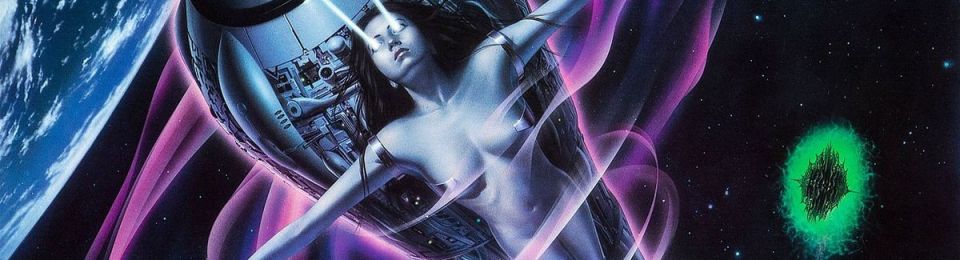
There’s weird, and then there’s Lifeforce. Tobe Hooper’s 1985 sci-fi horror fever dream didn’t just step outside the box—it set it on fire, turned it into a naked vampire, and launched it into orbit. Forty years on, this glorious trainwreck of a film still pulses with an unholy energy: part alien invasion thriller, part erotic vampire myth, part end-of-days apocalypse, and all unleashed Hooper. It’s a mess—but it’s a beautiful, ambitious, and absolutely unhinged mess.
Based loosely (and we stress loosely) on Colin Wilson’s novel The Space Vampires, Lifeforce begins like Alien and ends like The Omega Man, with an interstellar expedition to Halley’s Comet bringing home something ancient and devastating: a trio of seductive, humanoid vampires who drain the life—literally the force—from their victims. What follows is a strange cocktail of sci-fi espionage, metaphysical dread, zombie contagion, and enough full-frontal nudity to make the MPAA sweat through its polyester.
At the centre of it all is Hooper, hot off the back of Poltergeist (and still shaking off the questions about Spielberg’s creative control). With Lifeforce, he grabs the wheel, hits the gas, and swerves into chaos with wild-eyed conviction. This is Hooper unfiltered, blending gothic horror and pulp science fiction with operatic flair. The film is massive in scale—shot like a prestige epic, scored with bombastic orchestration, and featuring enough laser-beam FX to fry a satellite. It’s hard not to admire the sheer guts of it all.
There’s espionage too—cold war paranoia baked into the script like secret messages in a sandwich. The British government scrambles to contain the outbreak, while American astronauts (including a stiff but determined Steve Railsback) struggle to explain what the hell they brought back. At times, the film plays like The Day of the Jackal with energy-sucking space demons. Other times, it’s Dracula on a spaceship, as Mathilda May’s otherworldly alien lures victims with silence and skin, drawing a hypnotic trail of destruction through the ruins of London.
And it’s in May’s performance—ethereal, deadly, utterly magnetic—that Lifeforce finds its strange gravitational pull. She doesn’t speak a word, but commands the screen like a vampire goddess. She is both object and agent of desire, representing Hooper’s recurring obsession with sexuality as a monstrous, irresistible force.
Yes, it’s convoluted. Yes, it spirals into nonsense. But there’s a manic joy in how it barrels forward, ideas colliding midair like doomed satellites. Life-force theft, reanimation, psychic connections, body horror, possession—it’s all here, stitched together like a mad scientist’s pet project. The tone shifts from serious sci-fi to gothic melodrama to gonzo action, often within a single scene.
And yet, for all its excesses and flaws, Lifeforce endures. It’s campy and chaotic, but also strangely profound. Beneath the spectacle is a film about identity, human weakness, and the eternal hunger for connection—even if that connection destroys you.
The Prognosis:
In an era of sanitised blockbusters and streamlined storytelling, Lifeforce stands out as a relic of fearless filmmaking. It’s a film that swings for the stars and occasionally misses, but when it hits… it leaves a mark.
- Saul Muerte
 Surgeons of Horror