Cinema is a visual medium, sure—but Jaws proved that terror thrives in what you don’t see. The great irony of Spielberg’s breakout film is that it gave birth to the modern blockbuster by being almost entirely allergic to spectacle. For a movie that turned sharks into movie monsters and summer into a war zone, Jaws is visually… spare. Patient. Still.
And that’s precisely what makes it terrifying.
Forget what came later—digital sharks flailing across green screens, soaked in overlit gore and blaring musical stings. Spielberg’s Jaws stalks its prey like a documentary. The frame is wide. The pacing slow. We spend an absurd amount of time staring at empty ocean. Just water. Ripples. Rafts. Buoys. Maybe a distant swimmer. The camera drifts. And somehow, it’s unbearable.
Because what Spielberg did—and what modern horror so often forgets—is build suspense, not surprise. He knew the shark was broken, but he also knew the audience’s imagination wasn’t. So he made the sea itself the villain. The wide, blue unknown. A glassy abyss where anything could be lurking just beneath the surface—and usually is.
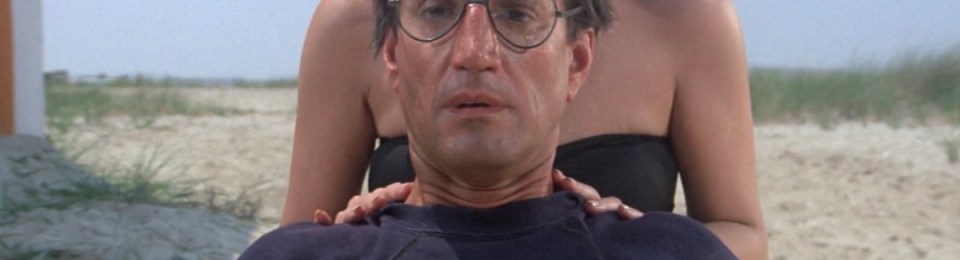
There’s that shot—that shot—where Brody sits on the beach, scanning the waves while tourists bob lazily through the frame. Spielberg shoots it in long lens, compressing the distance, flattening space. The people blur together. You can’t tell who’s safe. You know something’s coming, but you can’t see it. And then—boom—the scream. The thrashing. The blood. And the audience bolts upright in their seats, gasping like they were pulled under too.
This is the cinema of anticipation. It’s Hitchcock in a Hawaiian shirt, De Palma with a boat license. Spielberg understands that horror lives in the waiting. He lets dread accumulate like algae on the hull. You think about the sound. You think about the space. He gives you inches of shark, seconds of score, and it’s enough to poison your popcorn. It’s why you squirm during the pier scene—not because the monster is attacking, but because the camera just sits there, watching that broken plank slowly drift back to shore. One empty plank. One tension-sodden beat. The implications are more frightening than any splashy attack.
This technique didn’t just shape Jaws—it redefined modern horror language. You can trace its ripple effect through Alien, The Thing, The Descent, Hereditary, The Witch. All films that understand that showing less isn’t about budget—it’s about control. It’s about holding your audience in a vice grip of expectation and then delaying the release.
And yet, like all the best tricks, it’s one modern blockbusters keep forgetting. We now live in the era of sensory overload—monster movies that throw everything at you, all the time, like they’re afraid you’ll check your phone if they hold a shot longer than two seconds. But Jaws held the shot. It made you lean forward. It understood that fear isn’t a jump—it’s a crawl. A slow tide rising.
Fifty years later, it still works. Not because the shark looks real (it doesn’t). Not because the blood is convincing (it’s not). But because Spielberg knew how to manipulate empty space into anxiety. He turned the ocean into a haunted house. And once you’ve been inside, you don’t forget it.
- Saul Muerte
 Surgeons of Horror
Pingback: Still Waters Run Deep: 50 Years of Jaws” | Surgeons of Horror