Tags
1960s horror, 1960s retrospective, giallo, giallo horror, gothic, gothic horror, italian gothic horror
“Behind every shadow lies a secret. Behind every secret, a scream.”
🗝️ “Behind every shadow lies a secret. Behind every secret, a scream.”
By the time La bambola di Satana (The Doll of Satan) crept into Italian cinemas in 1969, the giallo genre was still sharpening its knives. Mario Bava had lit the fuse with The Girl Who Knew Too Much (1963) and Blood and Black Lace (1964), but it would be another year before Dario Argento’s The Bird with the Crystal Plumage pushed the subgenre into full flight. The Doll of Satan landed at a curious midpoint: a gothic thriller draped in giallo stylings, ripe with misty castles, erotic hallucinations, and a hooded killer lurking in the shadows.
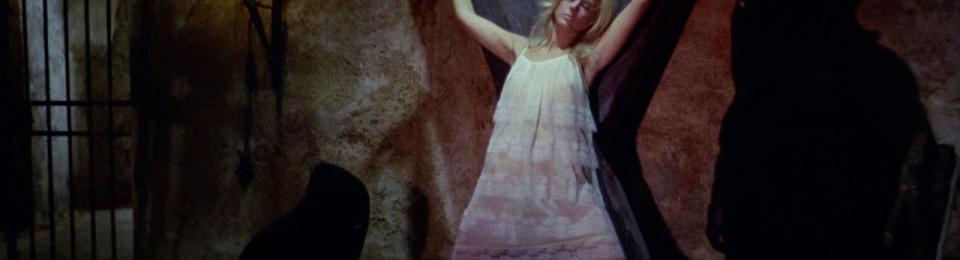
Directed by Ferruccio Casapinta—his only directorial credit—this occult-tinged thriller follows Elisabeth, a young woman returning to her family’s ancestral castle after her uncle’s mysterious death. As the inheritance looms, so do whispers of hauntings, cryptic locals, and ulterior motives. Elisabeth is soon plagued by bizarre, erotically charged visions and finds herself trapped in a web of deceit, culminating in dungeon-bound torture at the hands of a masked figure. Her fiancé, Jack, begins to suspect that the castle’s legend hides a far more human treachery.
While The Doll of Satan never fully commits to the baroque excess or stylish violence that would come to define giallo in the 1970s, it bears several of the genre’s fingerprints: a vulnerable woman in a labyrinthine estate, conspiracies surrounding wealth and inheritance, dreamlike hallucinations, and a killer whose identity is concealed behind cloaks and masks. Yet it’s still deeply tethered to the gothic tradition—with its rain-slicked graveyards, ancestral curses, and fog-choked corridors, the film feels caught in the final breath of the old horror world, even as it reaches toward the future.
There’s an undeniable camp charm in the way the film blends eroticism and suspense, from the exaggerated dream sequences to the near-operatic melodrama. Bruno Nicolai’s score—steeped in mood and menace—adds a ghostly elegance that elevates the film beyond its limited budget and occasionally clunky pacing. Casapinta may not have had the finesse of Bava or the bravado of Argento, but he delivers a stylish, if uneven, curiosity that flirts with the giallo blueprint.
The Prognosis:
The Doll of Satan stands as a minor, though intriguing, footnote in the evolution of Italian horror. It reflects a moment of transformation—when horror cinema in Italy was beginning to trade gothic gloom for lurid thrills, and the supernatural gave way to psychological menace. For giallo enthusiasts and completists, it offers a seductive glimpse into that transitional twilight, where haunted castles began to echo with the sound of switchblades.
- 1960s Retrospective Review by Saul Muerte
 Surgeons of Horror