Tags
1960s horror, 1960s retrospective, AIP, christopher lee, christopher wicking, Edgar Allan Poe, george hessler, Vincent Price
Gordon Hessler’s somber, atmospheric horror marks a transitional moment as American International Pictures’ Poe cycle edges toward a darker, more violent future.
By the end of the 1960s, the gothic horror cycle popularized by American International Pictures was showing distinct signs of wear. Lavish yet increasingly formulaic, the once-groundbreaking Vincent Price/Edgar Allan Poe collaborations — most notably directed by Roger Corman — had set a high-water mark earlier in the decade. The Oblong Box, directed by Gordon Hessler and released in 1969, represents both a continuation and a mutation of that tradition: a film steeped in the tropes audiences had come to expect, but tinged with a harsher, more morbid tone reflective of the cultural shifts at the end of the decade.
Although marketed heavily as another Poe adaptation, The Oblong Box in fact has little to do with the author’s original short story, borrowing only the title and the general theme of premature burial. Nevertheless, its atmosphere — a decadent English estate rotting under the weight of ancestral sins — fits neatly into the aesthetic universe cultivated by AIP’s earlier Poe pictures. Vincent Price, ever the consummate performer, slips comfortably into the role of Julian Markham, a man haunted by familial guilt and constrained by social appearances. Price’s presence alone is enough to anchor the film in the familiar tradition of velvet-draped madness and doomed legacies.
However, The Oblong Box also marks a departure from the more theatrical, florid excesses of Corman’s earlier works. Hessler, stepping into the director’s chair after Michael Reeves’ untimely death and dissatisfaction from AIP’s executives, brings a colder, more clinical eye to the material. The film’s violence is more explicit; its themes — colonial guilt, fratricide, exploitation — emerge less as melodramatic devices and more as genuinely disturbing undercurrents. It is a film less concerned with Poe’s romanticised morbidity than with a burgeoning appetite for psychological and physical horror.
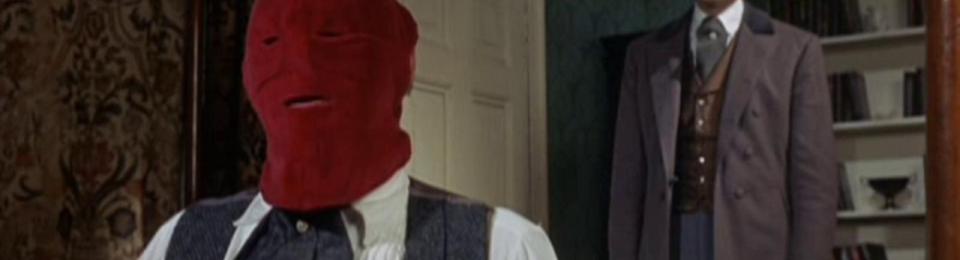
Christopher Wicking’s screenplay weaves in an uneasy undercurrent of imperialist critique, with the disfigured Sir Edward (played in part by Alister Williamson, though Price’s star power overshadows him) embodying the physical and moral consequences of colonial exploitation. The masked figure, red cloak swirling in the night as he seeks revenge, foreshadows the more explicit grotesqueries that would dominate British and European horror into the 1970s.
While The Oblong Box does not reach the stylistic heights of earlier Corman-Poe entries like The Masque of the Red Death or The Pit and the Pendulum, it nonetheless offers a compelling portrait of a genre — and a studio — in transition. Hessler’s film is handsomely mounted, if at times unevenly paced, and buoyed significantly by Price’s unerring ability to balance camp and gravitas. His Julian Markham is neither pure villain nor misunderstood hero, but a man slowly being devoured by forces he can no longer control, much like the American International Pictures horror line itself, inching toward its inevitable decline.
The Prognosis:
The Oblong Box stands as a fascinating artifact: a twilight entry that hints at both the glories of AIP’s earlier successes and the darker, less forgiving horror that the 1970s would embrace. It is not the purest distillation of Price’s talents nor Poe’s nightmarish imagination, but it remains a solemn, atmospheric bridge between eras — a coffin-laden corridor leading toward the more brutal horrors to come.
- 1960s retrospective review by Saul Muerte
 Surgeons of Horror