Tags
1960s horror, 1960s retrospective, Frankenstein, freddie jones, hammer films, Hammer Horror, peter cushing, simon ward, terence fisher, veronica carlson
Peter Cushing delivers his darkest turn as Baron Frankenstein in Terence Fisher’s brutal, uncompromising portrait of ambition unmoored from humanity.
Few characters in horror history have undergone as grim an evolution as Hammer Films’ Baron Victor Frankenstein. By 1969, the once-charming and impassioned scientist had metamorphosed into something altogether colder, crueller — and never more so than in Frankenstein Must Be Destroyed. Marking one of the studio’s boldest and bleakest entries, Terence Fisher’s film plunges audiences into a chilling moral abyss, anchored by Peter Cushing’s most malevolent portrayal of the Baron.
From the outset, Frankenstein Must Be Destroyed is suffused with an atmosphere of stark brutality. Gone is the romanticised ambition of earlier installments; in its place stands a portrait of Frankenstein as a calculating sociopath, concerned only with his own vindication. Peter Cushing, always a master of understated menace, turns in a performance of extraordinary steeliness — chillingly urbane one moment, terrifyingly ruthless the next. His Baron is a man for whom human life is but clay to be shaped, discarded, or destroyed in pursuit of scientific triumph.
Fisher, who had been instrumental in defining Hammer’s gothic aesthetic, embraces a far colder visual palette here. The film trades ornate castles and vibrant colors for stark, drained settings — a reflection of Frankenstein’s spiritual desolation. Even the violence feels less operatic and more intimately brutal, culminating in moments that strip the mythos of any lingering romanticism.
Central to the film’s enduring controversy is the much-discussed scene in which Frankenstein rapes Anna (Veronica Carlson) — a moment absent from the original script and forced upon the production by studio pressure. Both Cushing and Carlson vehemently opposed the inclusion, and their disapproval seeps into the scene’s palpable discomfort. While ethically troubling, the moment undeniably darkens the character beyond redemption, underscoring the film’s unflinching portrayal of moral collapse. It transforms Frankenstein from a misguided idealist into a full-fledged predator — a monster not of nature, but of willful cruelty.
Carlson and Simon Ward, portraying the beleaguered couple ensnared in Frankenstein’s machinations, deliver affecting performances that heighten the tragedy. Carlson, in particular, lends a dignified pathos to a role burdened by the demands of a narrative far more nihilistic than Hammer’s previous outings.
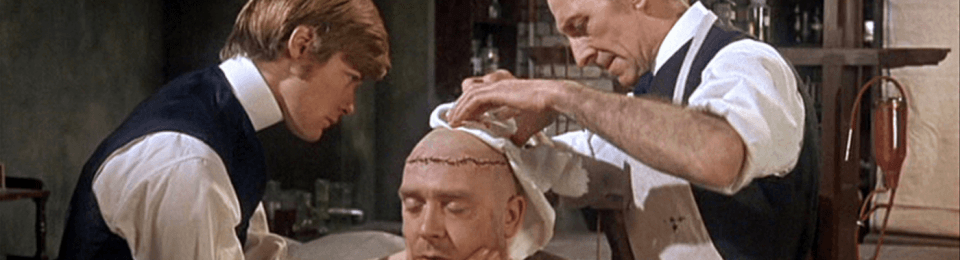
Freddie Jones, in his first major film role as the tragic Professor Brandt, is a revelation. His performance captures both the physical fragility and the mental anguish of a man resurrected against his will, trapped within a stolen body and a crumbling mind. Jones infuses Brandt with a quiet dignity and simmering rage, crafting a character whose humanity serves as a stark rebuke to Frankenstein’s inhumanity. His confrontation with Cushing in the film’s final act offers a rare glimmer of emotional depth amid the relentless bleakness, elevating the story beyond pure gothic horror into something far more sorrowful and profound.
Thematically, Frankenstein Must Be Destroyed confronts the corrosion of empathy under the guise of scientific pursuit. It suggests that evil need not spring from grandiose ambitions but from the erosion of everyday decency. Frankenstein’s destruction of lives — not in moments of passion, but through cold, bureaucratic calculation — offers a horror far more enduring than any stitched-together monster.
The Prognosis:
Frankenstein Must Be Destroyed stands as a stark outlier within the Hammer canon — a film willing to fully reckon with the darkness its iconic character had always flirted with. Though marred by studio-imposed controversy, it remains a harrowing, essential entry in the Frankenstein cycle — a reminder that sometimes the true monster wears the most respectable face.
- 1960s retrospective review by Saul Muerte
 Surgeons of Horror