A feverish plunge into Edo-era exploitation, where the beauty of art is carved from the cruelty of flesh.
By the late 1960s, Japanese director Teruo Ishii had cemented his reputation as a provocateur—an auteur of the abnormal whose films constantly tested the limits of good taste. Following the surreal sadism of his Joys of Torture series and the florid transgressions of Orgies of Edo, Ishii would return once more to the nexus of eroticism and agony with Inferno of Torture (徳川いれずみ師:責め地獄). Released in 1969, this film marked yet another swirling descent into the baroque horrors of Japan’s past, tinged with the obsessions of modern exploitation cinema.
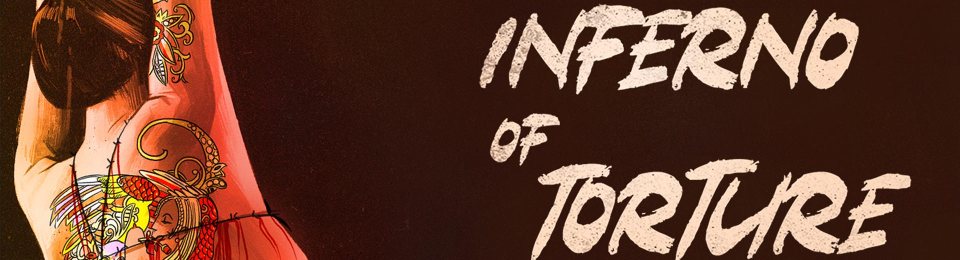
Set during the Tokugawa era, Inferno of Torture builds its narrative around the booming trade of tattooed geisha—women whose bodies are transformed into canvases to satisfy the exotic desires of wealthy Europeans. What begins as a lushly costumed tale of artisanship soon mutates into something darker and more sinister. The competition between two rival tattoo masters (each with their own brand of brutality and artistry) spirals into a portrait of obsession, commodification, and systemic cruelty, where the female form becomes both sacred and sacrificial.
Ishii’s camera lingers with equal reverence on the intricacies of traditional Japanese tattooing (irezumi) and the often shocking violence enacted to “preserve” or “perfect” these living artworks. His aesthetic is unmistakable: elaborate production design, garish colour palettes, and sudden, shocking cuts that blur the boundary between the ceremonial and the obscene. Here, torture is not only spectacle—it’s also currency. Beauty is literally etched into pain.
While some of Ishii’s contemporaries were leaning into more psychological or supernatural horror, Inferno of Torture embraced the physical and the performative. The film sits on a precarious edge, asking the audience to reckon with the allure of suffering while never quite condemning its purveyors. It is this ambiguity—this refusal to clearly moralise—that makes the film both fascinating and uncomfortable. Is it an indictment of patriarchal cruelty, or an indulgence in it? Ishii leaves that question open, daring the viewer to look closer.
It’s important to view Inferno of Torture not as an isolated work, but as part of Ishii’s greater obsession with the grotesque pageantry of pain. Like his earlier Shogun’s Joy of Torture (1968), this film pulls from real historical punishments and court practices but filters them through a lens of stylised surrealism. Yet, where Shogun’s Joy was fragmented and episodic, Inferno is more narratively cohesive—anchored by the rivalry of the tattoo artists and the women who bear the consequences of their egos.
As noted in our prior discussion of Ishii’s legacy, the director had a unique ability to cloak exploitation in aesthetics. Inferno of Torture exemplifies this duality. It is a film of contradictions: gorgeous yet grotesque, meditative yet exploitative, artistic yet undeniably sleazy. Ishii revels in this tension, crafting a work that is less about resolution and more about confronting the audience with their own thresholds of taste.
Inferno of Torture remains a vivid example of the extremities that defined the tail-end of the 1960s in Japanese genre cinema. It’s a challenging watch—not merely because of its brutality, but because of its beauty. That beauty, as Ishii reminds us again and again, comes at a price.
- 1960s retrospective review by Saul Muerte
 Surgeons of Horror