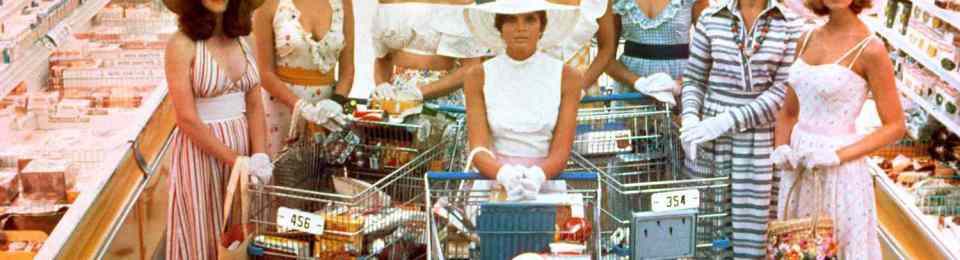
When The Stepford Wives premiered in 1975, it cast a satirical and sinister gaze on the idealised vision of suburban life, blending feminist critique with psychological horror. Based on Ira Levin’s 1972 novel, the film holds a mirror to societal anxieties, much like Levin’s earlier masterpiece, Rosemary’s Baby. Directed by Bryan Forbes and starring Katharine Ross in one of her finest performances, The Stepford Wives remains a provocative yet imperfect exploration of gender roles, technology, and societal conformity.
The story follows Joanna Eberhart (Ross), a photographer and mother who relocates to the seemingly idyllic community of Stepford, Connecticut, with her husband and children. As Joanna tries to settle into her new surroundings, she becomes uneasy about the other women in town, whose personalities are unsettlingly uniform and whose behaviour borders on robotic servitude. The unsettling truth about Stepford is slowly unveiled, exposing a malevolent force lurking beneath the neighbourhood’s polished exterior.
Much like Rosemary’s Baby (1968), The Stepford Wives trades on Levin’s ability to turn domestic spaces into suffocating prisons. Both stories centre on a woman whose autonomy is systematically stripped away by patriarchal forces disguised as loving partners or harmless neighbours. In Rosemary’s Baby, the terror lies in the spiritual exploitation of Rosemary, whereas Joanna’s nightmare is grounded in technological domination and societal expectations of perfection.
Levin’s sharp critiques of power dynamics, gender politics, and the veneer of progressiveness still resonate. However, The Stepford Wives lacks some of the timeless bite of Rosemary’s Baby. While the film is eerily prescient about the commodification of women and the pressures to conform to societal ideals, its dated portrayal of second-wave feminism and its white, upper-middle-class focus limits its broader cultural relevance today.
Ross’s portrayal of Joanna is the beating heart of the film. She imbues the character with a sense of independence and vulnerability, making her gradual realisation of the truth all the more harrowing. Her performance captures both the relatable frustrations of being a woman in a male-dominated world and the existential dread of losing oneself to that world.
Ross’s naturalistic acting helps ground the film’s more fantastical elements, making the Stepford women’s eerie perfection all the more jarring. Her chemistry with Paula Prentiss, who plays Joanna’s free-spirited friend Bobbie, adds a spark to the narrative, making Bobbie’s eventual “transformation” into an obedient housewife one of the film’s most haunting moments.
Viewed through a modern lens, The Stepford Wives is both progressive and outdated. Its critique of patriarchal control and the erasure of individuality remains potent, particularly in the era of social media perfection and AI technologies. However, its framing of gender politics feels rooted in a specific 1970s feminist context that doesn’t fully align with today’s intersectional conversations about gender, race, and class.
The film’s focus on affluent white women navigating the suburbs excludes broader discussions about marginalised groups, whose struggles with autonomy and societal expectations differ vastly. Additionally, the technological aspect of the Stepford wives feels charmingly anachronistic in a world where AI and robotics have advanced far beyond what the film envisioned.
Fifty years later, The Stepford Wives remains an important, if flawed, cultural artifact. It showcases Ira Levin’s talent for turning societal anxieties into gripping, horrifying stories while featuring a standout performance from Katharine Ross. Though its themes feel both ahead of their time and tied to a specific cultural moment, the film’s critique of conformity and gender dynamics continues to spark reflection.
In the end, The Stepford Wives is a chilling reminder that even the most idyllic façades often conceal darker truths. While not as timeless as Rosemary’s Baby, it endures as a cautionary tale about the dangers of idealised perfection and the cost of erasing individuality in pursuit of a false utopia.
- Saul Muerte
 Surgeons of Horror