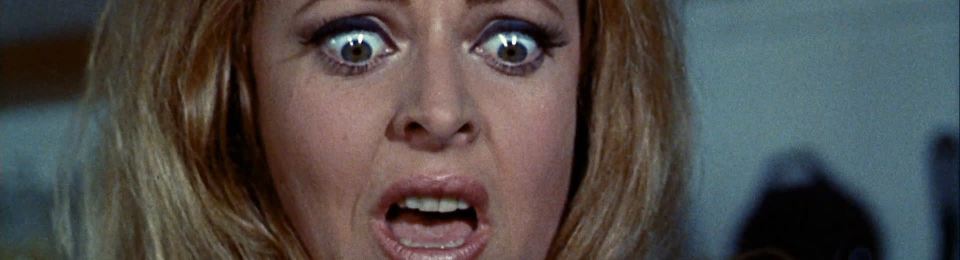
Peter Cushing, known for his commanding presence in countless Hammer Horror films, took a sharp turn with Corruption (1968), a grim and morally depraved tale of obsession, vanity, and murder. In this stark and sordid thriller, Cushing plays Sir John Rowan, a respected surgeon whose descent into madness highlights his versatility as an actor while leaving the audience grappling with the film’s graphic nature and troubling themes. Though it has garnered a reputation as an exploitative oddity, Corruption remains an intriguing, if flawed, artifact of 1960s horror cinema.
Cushing’s portrayal of Rowan is a revelation for fans more accustomed to his roles as noble heroes or cunning villains in Hammer’s Gothic settings. Here, he plays a man driven by love and guilt to commit horrifying acts. When Rowan’s fiancée, Lynn (Sue Lloyd), suffers facial disfigurement after a freak accident, he becomes consumed by the desire to restore her beauty. This desire leads him to a gruesome discovery: the glandular fluids of murdered women can temporarily heal her scars. Cushing imbues Rowan with a tragic intensity, showing his slow unraveling as he succumbs to his monstrous impulses. It is one of his most unsettling performances, proving his ability to shine even in less-than-ideal material.
Corruption is as much an exploitation film as it is a psychological horror. Director Robert Hartford-Davis pulls no punches, delivering scenes of shocking violence that push the boundaries of what audiences might have expected from a film starring Cushing. The camera lingers on the grisly aftermath of Rowan’s murders, which gives the film an almost voyeuristic quality. This rawness, combined with its lurid themes, has divided critics and audiences alike. For some, it is a bold exploration of vanity and the destructive lengths to which one might go for love. For others, it is an uncomfortable and gratuitous experience.
One of the film’s most striking elements is its embrace of its time period. Unlike the Gothic castles and period settings of many other Cushing films, Corruption is firmly rooted in the Swinging ’60s, with its mod fashion, psychedelic lighting, and jazz-infused score. This contemporary backdrop heightens the film’s sense of moral decay, as Rowan’s sterile, clinical world collides with the vibrant, hedonistic culture of the era. The juxtaposition makes Rowan’s actions feel all the more jarring and alien.
Despite its fascinating premise and Cushing’s committed performance, Corruption falters in several areas. The script lacks nuance, often relying on shock value rather than exploring the deeper psychological or ethical implications of Rowan’s actions. The pacing can be uneven, with moments of genuine tension interspersed with scenes that drag. The supporting cast, while serviceable, struggles to match Cushing’s gravitas, and some of the dialogue feels stilted.
Additionally, the film’s depiction of women as victims of Rowan’s experiments has drawn criticism for its exploitative nature. While this can be seen as a reflection of the film’s themes—the objectification of women and society’s obsession with beauty—it can also feel gratuitous and uncomfortable to modern audiences.
Corruption was met with mixed reviews upon its release, and its graphic content ensured it was not for the faint of heart. However, over time, it has gained a cult following, particularly among fans of Cushing and aficionados of obscure 1960s horror. Its willingness to push boundaries and explore darker, more contemporary themes sets it apart from many of its peers, even if it doesn’t always succeed in its execution.
For those willing to overlook its flaws, Corruption offers a fascinating glimpse into the darker corners of 1960s horror. It’s a film that dares to be different, and while it may not achieve the same level of artistry as some of Cushing’s other work, it remains a memorable entry in his illustrious career.
At its core, Corruption is a film about obsession, guilt, and the price of vanity. It’s a story that feels both timeless and firmly rooted in its era, with Peter Cushing delivering a performance that elevates the material beyond its exploitative roots. While not a masterpiece, it’s a fascinating curiosity for fans of vintage horror and a testament to Cushing’s ability to bring depth and humanity to even the most grotesque characters.
- Saul Muerte
 Surgeons of Horror