Tags
1960s horror, 1960s retrospective, alain delon, brigitte bardot, Edgar Allan Poe, federico fellini, jane fonda, louis malle, peter fonda, roger vadim, terence stamp
The 1968 anthology film Spirits of the Dead (Histoires extraordinaires) brings together the talents of three European auteurs—Roger Vadim, Louis Malle, and Federico Fellini—to adapt the macabre tales of Edgar Allan Poe. What emerges is a trio of distinct yet interconnected visions, each exploring existential dread, moral decay, and the haunting spectre of the human condition. Elevated by an outstanding cast, the film is an intriguing, if uneven, entry into the anthology genre, showcasing how European sensibilities can bring Poe’s gothic imaginings to life.
The anthology boasts a stellar ensemble cast, whose performances anchor the film’s ambitious explorations. Jane Fonda dazzles in Vadim’s Metzengerstein, playing the cruel and capricious Countess Frederique. Her transformation from cold-hearted aristocrat to a haunted, guilt-ridden soul is as mesmerising as it is chilling. Peter Fonda, cast as her distant cousin and object of obsession, brings a quiet dignity that starkly contrasts with Jane’s volatile energy.
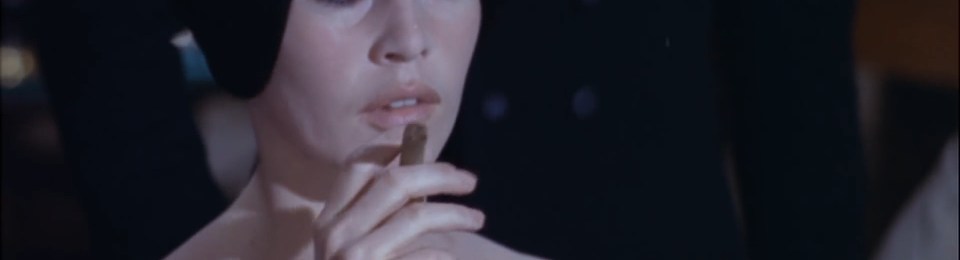
In William Wilson, directed by Louis Malle, Alain Delon embodies the titular sadistic officer with unnerving precision. His torment at the hands of his doppelgänger (also Delon) highlights the psychological depth of Poe’s tale. Brigitte Bardot’s supporting role as a card-playing temptress adds an unexpected layer of glamour to this dark parable of guilt and morality.
Finally, in Fellini’s Toby Dammit, Terence Stamp delivers an unforgettable performance as a disillusioned actor spiraling into madness. Stamp’s haunted expressions and erratic demeanour perfectly capture the surreal and nightmarish tone of Fellini’s segment, a loose adaptation of Poe’s “Never Bet the Devil Your Head.” His interactions with the Devil, personified as a sinister child, are both grotesque and strangely poignant.
Each segment of Spirits of the Dead tackles themes of identity, power, and existential collapse, albeit in wildly different styles. Vadim’s Metzengerstein is steeped in gothic decadence, reflecting on the destructive power of unchecked desire and the inescapability of fate. While its pacing occasionally falters, the visual opulence—from lavish costumes to eerie, smoke-filled landscapes—renders it an immersive experience.
Malle’s William Wilson takes a more restrained approach, employing stark visuals and a taut narrative to delve into the duality of human nature. The moral struggle of Wilson and his ultimate reckoning underscore the existential quandaries at the heart of Poe’s work, even as the segment’s subdued tone contrasts with the more extravagant entries.
Fellini’s Toby Dammit is a surreal and satirical masterpiece, brimming with the director’s signature flair. The segment transforms Poe’s cautionary tale into a psychedelic fever dream, replete with grotesque imagery and biting commentary on fame and artistic disillusionment. Fellini’s bold, idiosyncratic vision may overshadow the other segments, but it leaves an indelible impression.
Visually, Spirits of the Dead is a sumptuous affair. From Vadim’s lush, romantic landscapes to Malle’s austere compositions and Fellini’s kaleidoscopic grotesquery, the film offers a rich tapestry of styles that reflect the directors’ unique interpretations of Poe’s themes. The musical score, composed by various artists, further enhances the atmospheric dread permeating each story.
As with many anthology films, the unevenness of Spirits of the Dead is both its strength and its weakness. The shifts in tone and style between segments can be jarring, yet they also highlight the versatility of Poe’s narratives and their capacity to inspire wildly different interpretations. While not every segment achieves perfection, the film’s ambition and the performances of its exceptional cast ensure its place as a fascinating artifact of 1960s European cinema.
In revisiting Spirits of the Dead, one is reminded of the timeless allure of Edgar Allan Poe’s tales and the creative possibilities they offer. This anthology stands as a testament to the enduring power of collaboration and the ways in which distinct artistic voices can coalesce to explore the darkest corners of the human psyche.
- Saul Muerte
 Surgeons of Horror