Tags
die die my darling, hammer films, Hammer Horror, silvio narizzano, stefanie powers, tallulah bankhead
By the mid-1960s, Hammer Films had firmly established itself as a powerhouse of Gothic horror, but the studio was also exploring new directions, particularly in the realm of psychological suspense. Fanatic (1965), also released under the more sensational title Die! Die! My Darling!, is a prime example of Hammer’s foray into the thriller genre. While not as widely celebrated as their more iconic horror offerings, Fanatic stands as a testament to Hammer’s versatility, driven largely by a strong central performance from Stefanie Powers.
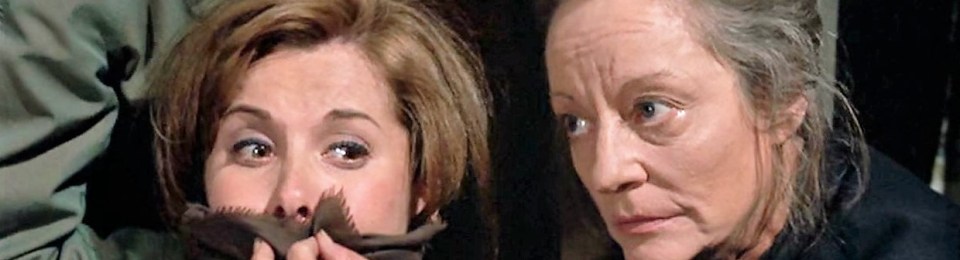
Based on the novel Nightmare by Anne Blaisdell, Fanatic tells the story of young American woman Patricia Carroll (Powers) who visits the eccentric Mrs. Trefoile (Tallulah Bankhead), the mother of her deceased fiancé. What begins as a courteous visit quickly spirals into a nightmarish ordeal, as Mrs. Trefoile’s fanatical religious beliefs and obsession with her late son lead to Patricia’s imprisonment and psychological torment.
Stephanie Powers, then in the early stages of her career, carries the film with an earnest portrayal of a woman trapped in a living nightmare. Powers’ performance is commendable, particularly given the film’s low budget, which required her to anchor the tension and suspense with limited resources. Her ability to convey both vulnerability and resilience adds depth to a role that could easily have been one-dimensional.
Tallulah Bankhead’s turn as the fanatical Mrs. Trefoile is the film’s other standout performance, providing a chilling counterbalance to Powers’ youthful energy. Bankhead, in her final film role, delivers a memorably menacing portrayal of a woman unhinged by grief and religious fervor. Her theatrical background lends a certain gravitas to the role, elevating the material beyond its modest origins.
Fanatic is also notable for its place within Hammer’s broader pivot towards suspense thrillers during the early to mid-60s. Following the success of Paranoiac (1963), directed by Freddie Francis and starring Oliver Reed, Hammer recognized the potential of psychological thrillers as a complement to their established horror lineup. Films like Maniac (1963) and Nightmare (1964) explored similar themes of mental instability, isolation, and the thin line between sanity and madness, all wrapped in a Hitchcockian veneer.
While Fanatic may not reach the heights of these earlier efforts, it remains a solid entry in Hammer’s suspense catalog. The film’s claustrophobic setting—a decaying, isolated mansion—serves as a perfect backdrop for the escalating tension, a hallmark of Hammer’s atmospheric storytelling. Director Silvio Narizzano, better known for his work on the British New Wave, brings a certain stylistic flair to the proceedings, though the film occasionally struggles to maintain its momentum, particularly in its slower middle act.
In retrospect, Fanatic is a film that, while not groundbreaking, offers a fascinating glimpse into Hammer’s experimentation with genre during the 1960s. It’s a film that bridges the gap between their Gothic horror roots and the psychological thrillers that would continue to evolve throughout the decade. Stephanie Powers’ performance, coupled with Tallulah Bankhead’s swan song, makes it a worthy watch for fans of Hammer’s broader oeuvre, even if it doesn’t quite achieve the same level of suspense as its contemporaries.
Overall, Fanatic is a modest but intriguing chapter in the Hammer Films legacy. It showcases the studio’s willingness to push beyond its comfort zone and embrace new forms of terror—this time not through monsters and mad scientists, but through the all-too-real horrors of fanaticism and psychological abuse. As Hammer’s suspense thrillers go, Fanatic may not be the most polished, but it certainly leaves its mark.
- Saul Muerte
 Surgeons of Horror