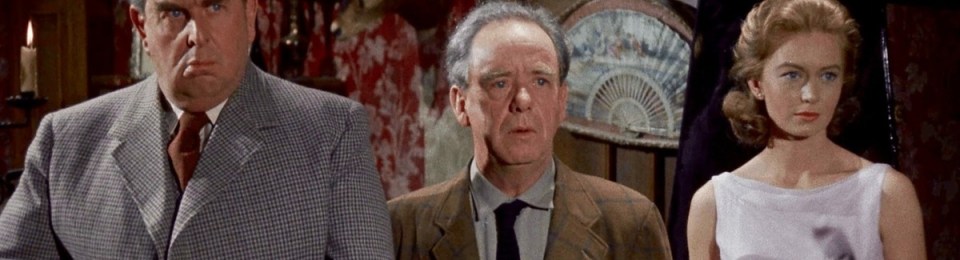
When William Castle, known for his gimmicky horror films, teamed up with Hammer Films, the collaboration seemed promising on paper. Castle, with his flair for sensationalism, and Hammer, with its reputation for producing quality horror, seemed like a match made in cinematic heaven. However, their 1963 remake of The Old Dark House ultimately struggled to rise from the shadows cast by the 1932 Universal Pictures version directed by James Whale and starring Boris Karloff.
The original The Old Dark House is revered as a classic, blending atmospheric horror with dark comedy. Karloff’s menacing presence and Whale’s masterful direction created an eerie and engaging experience. Castle’s remake, while attempting to honor the original, unfortunately, falls short in capturing the same magic.
One of the main issues was the decision to play the film as a comedy horror. While the 1932 version had its share of dark humor, Castle’s approach leaned heavily on the comedic elements, which didn’t quite resonate with audiences. The tone was inconsistent, and the humor often felt forced, detracting from the suspense and horror that the story needed. This misstep in tone was particularly problematic for British audiences, where the film’s distribution faced significant challenges. The comedy horror angle proved to be a difficult sell, and as a result, the film struggled to find its footing in the UK market.
Despite the film’s shortcomings, there were some notable aspects to appreciate. The cast, featuring Tom Poston, Robert Morley, and Janette Scott, delivered commendable performances. Poston, in particular, brought a certain charm to his role, and Morley’s portrayal of Roderick Femm added a touch of eccentricity. Additionally, the film’s twist, while not groundbreaking, provided a gleeful deviation from the expected and injected some much-needed intrigue into the story.
Visually, Castle’s version does have its moments. The set design captures the Gothic atmosphere well, and there are flashes of creativity in the cinematography. However, these elements are not enough to elevate the film above its structural weaknesses.
The alliance between Castle and Hammer Films was an unfortunate mismatch. Castle’s penchant for campy horror and Hammer’s traditional Gothic approach didn’t blend seamlessly, resulting in a film that felt disjointed. The potential for a successful remake was there, but the execution fell flat, hindered by conflicting creative visions and an ill-conceived genre blend.
The Prognosis:
The Old Dark House (1963) is a somewhat failed attempt to recreate a classic. While it boasts a promising cast and a few enjoyable moments, it struggles to make a lasting impact. The mismatched collaboration between William Castle and Hammer Films, combined with the difficulties of balancing comedy and horror, ultimately hindered the film’s success. For those interested in exploring Castle’s filmography or Hammer’s ventures into different genres, it remains a curious but flawed entry in their respective catalogues.
- Saul Muerte
 Surgeons of Horror