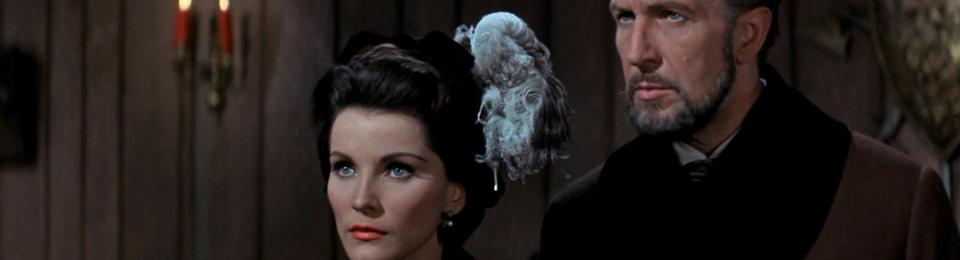
The Haunted Palace (1963), directed by Roger Corman and starring Vincent Price, is one of the eight collaborations inspired by the works of Edgar Allan Poe. While the film has its moments of atmospheric dread and solid performances, it doesn’t quite reach the heights of some of the duo’s more celebrated works. Nonetheless, it remains a noteworthy entry in the Corman-Price-Poe canon, primarily due to its cast and the unique blend of Poe’s and H.P. Lovecraft’s influences.
Roger Corman and Vincent Price teamed up to create a series of films loosely based on the works of Edgar Allan Poe, and The Haunted Palace stands out as an interesting deviation from the formula. While the title and promotional material suggest a Poe adaptation, the film is actually based on H.P. Lovecraft’s novella The Case of Charles Dexter Ward. This blending of Poe’s gothic sensibilities with Lovecraft’s cosmic horror provides a unique, though somewhat uneven, narrative experience.
Corman’s direction, as always, is efficient and atmospheric, making the most of the limited budget. The film’s set design and use of color contribute to its eerie ambiance, creating a suitably oppressive atmosphere. However, the film’s pacing occasionally falters, with moments of tension undercut by slower, less engaging scenes.
Vincent Price delivers a dual performance as Charles Dexter Ward and his malevolent ancestor, Joseph Curwen. Price’s portrayal of Curwen is particularly compelling, showcasing his ability to embody both charm and menace. His performance is the film’s anchor, providing a sense of continuity and gravitas even when the narrative wavers.
The inclusion of Lon Chaney Jr. adds another layer of interest to the film. Chaney, known for his significant contributions to horror cinema, brings a sense of gravitas to his role as Simon Orne, Curwen’s loyal servant. His presence serves as a reminder of the film’s roots in classic horror, bridging the gap between the golden age of monster movies and the more psychological horror that Corman and Price were known for.
The Haunted Palace excels in creating a visually rich and atmospheric experience. The gothic sets, combined with the moody cinematography, evoke a sense of dread that is characteristic of Corman’s best work. The film’s exploration of themes like ancestral guilt and the supernatural aligns well with Poe’s literary legacy, even as it diverges into Lovecraftian territory.
However, the film’s narrative structure is less successful. The fusion of Poe and Lovecraft results in a story that sometimes feels disjointed, struggling to balance the psychological horror of Poe with the cosmic terror of Lovecraft. This inconsistency can be jarring, preventing the film from achieving the same level of cohesion seen in other Corman-Price collaborations like The Masque of the Red Death or The Pit and the Pendulum.
Additionally, while Price’s performance is strong, some of the supporting characters lack depth and development, making it difficult for the audience to fully invest in their plights. The film’s slower moments detract from the overall tension, leading to a pacing that feels uneven.
The Prognosis:
The Haunted Palace may not be the strongest entry in the Corman-Price-Poe series, but it remains a film of interest for fans of classic horror. Its atmospheric visuals, strong performances from Vincent Price and Lon Chaney Jr., and the intriguing blend of Poe and Lovecraft make it a unique, if flawed, addition to the genre.
In retrospect, The Haunted Palace stands as a testament to the creative risks taken by Corman and Price, as well as their ability to craft memorable horror experiences even when the material isn’t at its strongest. While it may not reach the heights of their best work, it remains a fascinating piece of horror history, worthy of appreciation for its ambition and atmospheric strengths.
- Saul Muerte
 Surgeons of Horror