Tags
dakota fanning, eli arenson, georgina campbell, Ishana Night Shyamalan, m night syamalan, m. night shyamalan, the watchers
The Watchers, directed by Ishana Night Shyamalan in her feature debut, is a supernatural horror film that weaves Irish folklore into its narrative fabric. Despite its intriguing premise and moments of visual splendor, the film struggles to break free from the shadow of its influences, offering a mixed bag of thrills and disappointments.
The plot centers on Mina (Dakota Fanning), an American immigrant in Galway, Ireland, who becomes entangled in a nightmarish scenario involving mysterious entities known as ‘The Watchers.’ As Mina navigates the dangers of the forest and the secrets of the Coop, the film delves into Irish folklore, specifically the myth of changelings—fairies that mimic and replace humans. This folklore, rich and unsettling, serves as a fascinating backdrop, yet the film sometimes falters in fully integrating these mythic elements into a cohesive and gripping story.
Ishana Night Shyamalan’s directorial style bears clear similarities to her father, M. Night Shyamalan, who produced the film. Both directors share a penchant for atmospheric tension and twisty narratives. However, The Watchers often feels like a pale imitation of M. Night’s more successful works. Ishana’s attempts to emulate her father’s knack for suspense and surprise occasionally fall flat, resulting in a narrative that lacks the punch and coherence needed to sustain its ambitious premise.
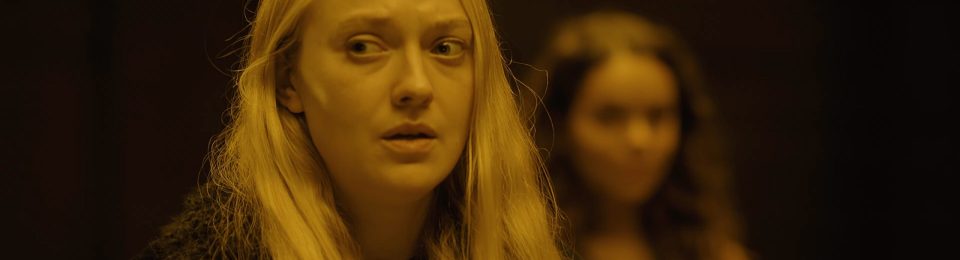
The cinematography by Eli Arenson is one of the film’s strongest assets. The lush, verdant landscapes of Ireland are captured with a richness that adds depth to the setting, and the claustrophobic interiors of the Coop are effectively oppressive. Certain scenes, particularly those in the catacombs, stand out for their visual flair and chaotic energy, providing a welcome jolt of excitement in an otherwise uneven film. These sequences are a testament to Shyamalan’s potential as a visual storyteller, even if the overall execution leaves something to be desired.
One major flaw in The Watchers is its clumsy narrative structure. The film’s pacing is uneven, with moments of tension frequently undercut by sluggish scenes that fail to advance the plot or develop the characters meaningfully. This disjointedness makes it difficult for the audience to stay engaged, as the film often loses momentum just when it should be ramping up the suspense. Additionally, the character development is inconsistent, with some characters feeling well-rounded and others remaining one-dimensional and underexplored. The back-and-forth shifts in tone and focus detract from the film’s overall impact, leaving viewers with a sense of missed potential.
The cinematographic choices, while sometimes beautiful, can also be disorienting. Too many scenes are shot with a shaky, swirling camera that makes it feel as if the viewer is trapped inside a washing machine. This approach, likely intended to heighten the sense of chaos and fear, instead often leaves the audience feeling more dizzy than scared.
The film’s incorporation of changeling mythology, however, is commendable. Irish folklore about these malevolent fairies adds a layer of historical intrigue to the story. The changelings’ ability to mimic humans and their aversion to sunlight are well-exploited plot points, although the execution sometimes lacks the finesse needed to truly terrify.
The familial ties to M. Night Shyamalan have also drawn comparisons, not always favorable. Critics have noted Ishana’s stylistic attempts to mirror her father’s work, which at times overshadow her own voice. Despite this, her efforts to carve out a space in the horror genre are evident, and she shows promise, particularly in her handling of atmosphere and visual storytelling.
In conclusion, The Watchers is a film of highs and lows, it is enriched by lush cinematography and intriguing use of folklore. Ishana Night Shyamalan’s debut showcases her potential as a filmmaker, even if it occasionally feels overshadowed by her father’s legacy. For fans of supernatural horror and Irish mythology, The Watchers offers an interesting, if uneven, viewing experience.
The Prognosis:
While it may not fully deliver on its promise, it offers glimpses of a director finding her voice and brings a fresh perspective to the genre’s rich tapestry of myth and lore.
- Saul Muerte
 Surgeons of Horror